Hope Builders Group
Join a Hope Builders Group to find the connection and support you need to grow your relationship with Jesus Christ.
__largepreview__.webp)
What I wanted to start off with, since we didn't have the children, and if we would have had a children's time, this is what I really would have wanted to do, so now you guys get to be the children. If you don't have issues like with hips or knees or back or horrible, okay, that eliminates almost everything. If you don't have issues that allow you, if your issues are bad enough that allow you to stand on one foot, will you stand and help me with this today? In just a second, I don't wanna push it too much.
You might put your hand over the chair in front of you. Stand on one foot, who can do that? Okay, clap for yourselves, you guys rock. Okay, now stand on one foot again, hold it, hold it.
Now close your eyes. As soon as you go down, sit down. You just quit, good job.
What that demonstrated to me was when I had knee problems, the doctor said, go to a physical therapist. So I went through physical therapy and we did things that would strengthen it, but he also did balance exercises with me. And in those balance exercises, I had to stand on one foot.
And then when I got really good on that, I stood on this mat that kind of had a ball in the middle that would rotate a little bit. And pretty soon when I got that down, he started telling me to close my eyes. And it made all the difference in the world.
Now those of you who understand science, where is our balance controlled from? Inner ear, deep in there. And so what do your eyes have to do with your balance? Keep your eyes to the horizon. I thought you said Verizon the first time, then I cleared it up in my mind.
That means you're looking at your phone all the time and it messes. The reason, it's like we almost think our eyes hold us up. That when we're talking about our senses, like our sight, we are normally, when you have good eyesight, you're over-reliant, I say you, we're over-reliant on our sight.
And our sight doesn't mean we're all born in Missouri, like me, the show me state, but we're overly reliant on our sight, that our sight overrides our other senses, that if we don't see it, sometimes it doesn't click if we hear it. If we don't see it, how many of you love doing tests with food or something with your eyes closed and seeing what it is? What do you start relying on then? Taste, smell, taste and smell are very interactive. And you know, like your taste, like everything when I had, when I was recovering from COVID, I had several months where all cooked meat smelled like burnt meat and it all smelled the same.
Do you know how painful that is for someone? And then when I was driving back from Stilwell, when the breeze hit just right at about 169th in Metcalfe, there's a landfill, and the breeze would hit just right and you could smell the landfill. And it smelled the same to me. That was so brutal.
Eventually it came back, so you don't have to cry for me. But sometimes we rely on our senses too much. Taste, sight, hearing, feeling, smelling, all those things can help us respond to the world and react to the world.
Like if a food doesn't smell good, how many of you wanna eat it? How many of you have a teenager that says, this milk doesn't smell right, would you like to taste it, dad? And I always say, no, I'm good. We can just throw that out. The over-reliance on our senses is kind of like realizing when we're standing on one foot and we close our eyes that suddenly it's not so easy to balance.
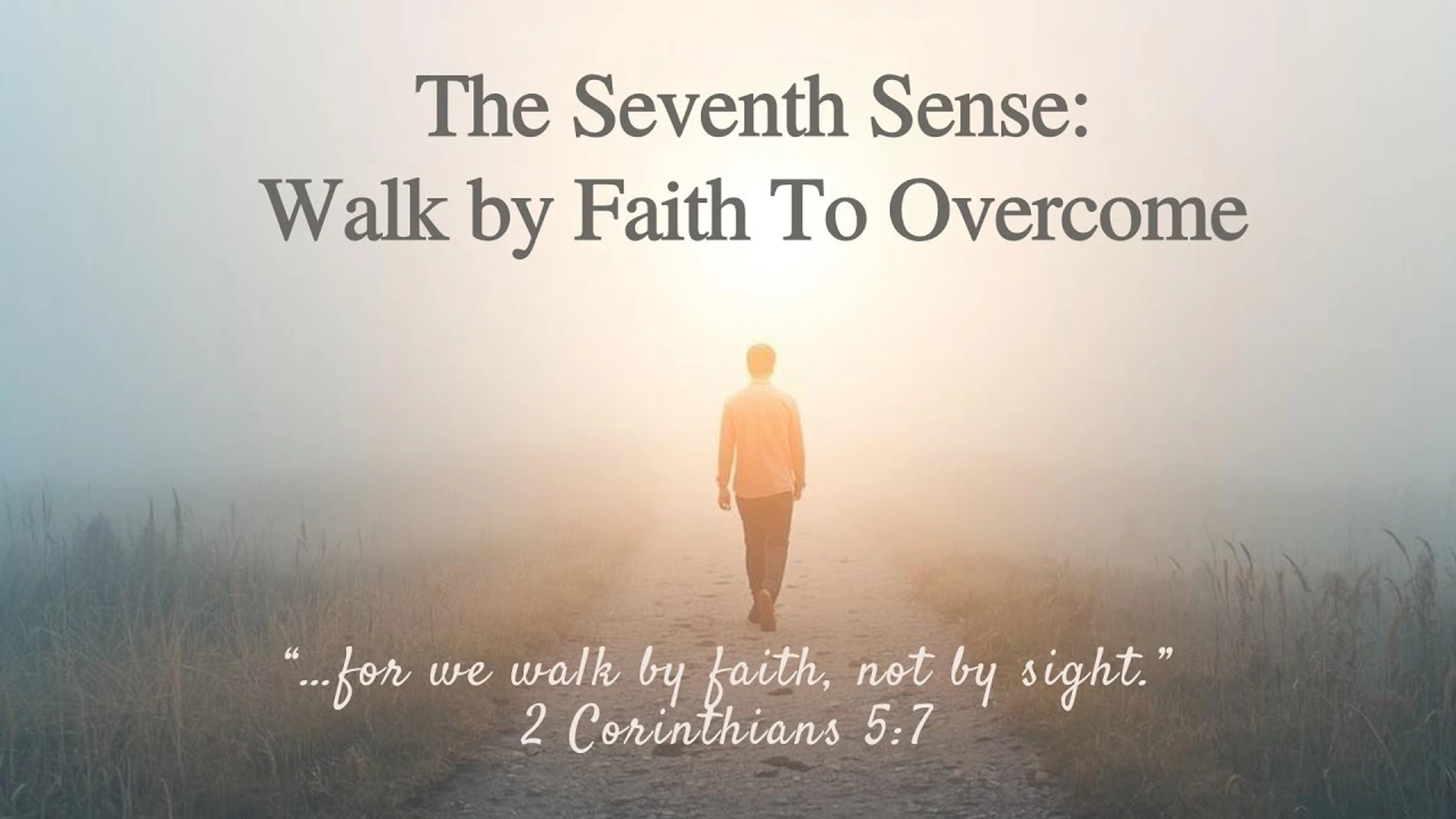
In our lives, when we're over-reliant on our five senses, we then start missing things. This sermon series is called The Seven Senses. And our seventh sense, walk by faith.
And it's based on 2 Corinthians 5-7. I gotta tell you the truth that we were going to a worship services a couple Saturdays ago and Dana was going to and on my way there, I was praying and all of a sudden this verse just hit me. And my first thought was that it would be about a sixth sense but instead of just our five senses, a sixth sense but I started thinking of so many different things like people who say they have a sixth sense of premonitions and their intuition and these other things and what I admit comes to my mind is whispering, I see death.
And when I did that, I was like, man, am I gonna do a whole sermon series on the sixth sense? And I realized, well, we have other senses that are in our head that might not, if they are led by anything that is some sort of a spirit and you don't have a relationship with God, you better not rely on that as your sixth sense. But with our sixth sense, we still have responses with our gut that are kind of like intuition that are based on our knowledge and experience and how we respond and we react and we take in information through that sixth sense. So I'm gonna talk about during this series our seventh sense and the truth is even as followers of Jesus Christ, we rely so much on our other senses that we tend to ignore this seventh sense of the Holy Spirit, of walking by faith, of trusting in God when we can't see it.
That is not always easy to do. If it's always easy to do, then good for you. When we trust in God and we see beyond ourselves, that is something amazing.
We stand as you are able. We're gonna go through the whole book of 2 Corinthians, but I think everything kind of focuses around and builds to and develops 2 Corinthians 5-7, for we walk by faith and not by sight. Today we're gonna look at one through five.
For we know that if the tent that is our earthly home is destroyed, we have a building from God, a house not made with hands, eternal in the heavens. For in this tent we groan, longing to put on our heavenly dwelling. If needed, if indeed by putting it on, we may not be found naked.
For while we are still in this tent, we groan, being burdened. Not that we would be unclothed, but that we would be further clothed, so that what is mortal may be swallowed up by life. He who has prepared us for this very thing is God, who has given us the spirit as a guarantee.
The word of God, inspired by God, for the people of God. Thanks be to God. Amen.
You may be seated. Now, if we could just have the slide that is just the background. That, this is, it gives us a great picture.
I'll let Lori explain the process of how she put this together. But it gives us an incredible picture of what we are gonna talk about. Metaphorically, this is the path that we are on, living in these mortal bodies, in this limited world.
We are hopefully on this path to walk by faith and not by sight. If you can tell, there's someone walking, there's a path, and just first of all, with your senses. What senses do you, when you study that picture, what senses come to mind and why? Sight.
What are the limitations on sight? The fog, low visibility. But somehow, through the fog, you can see the? The light. That's pretty amazing.
That is such a metaphor of life, of walking with Jesus. What other senses do you have there? Smell, what are you smelling? The moisture, the wet grass, good. What do you hear? Silence, what else? It's a still picture, so.
Pretend it's in Kansas, what do you hear? The wind, and you feel the wind. And you feel, what do you feel? The gravel below your feet. And you hear, there could be animals that you hear on there.
There could be so many. I don't know about taste in this, unless a bug flies in your mouth, I'm not sure. But what we have is a representation of what it means to walk by faith and not by sight.
I mean, we have very limited view of what's in front of us, and that's half of what being a Christian is. It's a lot of what being a Christian in this life is as we grow in our faith, then we live more by that faith, and we live more by seeing through the fog. Is the world ever a fog to seeing God? There's a fog all the time.
My mom used to say when she was confused or someone else was confused, are you in a fog right now? But really, when it comes to faith, we all have to work through that fog and see the light through the fog, and trust that there is something there beyond this world and what we have here before us. And then we have another thing that's limited that isn't just our sight. When we take this another step further, we have those bodies.
I mean, not everybody could stand when we stood on one foot, and I don't know. This is what you have to look forward to, guys. Watch this.
Who has aches and pains every day of their life? Not everybody, but a lot of people. Who has things that you have had that physically limit you in your life from doing what you wanna do or what you once did or however that is? No matter how hard we work, we still have physical, emotional, cognitive, and spiritual limitations. Is that a long way of saying we're imperfect? We have things that hold us back, and sometimes they may hold us back to the point where we say this can't be done or I can't do this, and we walk by what we have limited in this world, like our senses and like our own bodies, and we don't realize that God can do so much more when we walk by faith.
Now, one thing we have to be very clear on when we walk by faith and not by sight is that faith in God, the true God, Father, Son, and Holy Spirit isn't blind. It's not blind faith. It's not just saying, okay, I'm gonna step off the edge of this cliff, and God's gonna take care of me.
It's more of a faith of trusting in God and knowing God is walking with you and listening to God and spending time with God, and the more time you have with God, the more you are surrounded by others who spend that time with God and are growing in their faith, the more we can walk by faith and not by our sight, not by our limitations, not by the things that say, no, it can't be done. If we're listening to God, maybe God says no, too, but maybe God is saying, step out in faith, trust in God, trust in me to know that I will work through this with you. When we walk by our seventh sense, faith breaks down barriers and empowers us to overcome.
When I was studying Greek in seminary, the word that was one of the basic words, like they wanted us to know words that were very prevalent in the New Testament because it was studying Greek, and one of the words I remember, when I see the word know in the Bible, not no, but k-n-o-w, not no, but k-n-o-w, do you know? K-n-o-w. I think of the word gnosko. The word gnosko is what they taught us.
It's a deeper, more experienced kind of knowing to learn to know, to come to know, to get a knowledge of, perceive, and feel. Now, in the Greek, there's a slight nuance, but that is the one that they pounded in our heads the most in Greek, gnosko, but there is another word in Greek that is used called eido. Eido is like book knowledge or witness.
It says to perceive with the eyes or any sense, to know, to get knowledge of, to understand, perceive. Now, they both say perceive, but the slight nuance is if you think of what you know based on your senses, it might be more the word eido. And I say that because Paul is using eido purposely because in verse one, he uses eido where he says, for we know that if the tent is our earthly home is destroyed, wow, I didn't even need the Bible.
Look at that. We have a building from God, a house not made in heavens, but eternal in the heavens. We know that this tent, that is the Greek word eido, meaning we know based on what we have perceived, what we have seen, what we have experienced with God.
And it leads up to, in verse six, it says, so we are all of good courage. You can't pull that one up, sorry. We know that while we are at home in the body, we are away from the Lord.
We know eido, and then he goes on to say, for we walk by faith and not by sight. Using that, connecting it to our senses, basically saying this is a sense that is stronger and more helpful than what you think you know through what you see and what you hear. A sense that comes when we walk by faith and not by sight.
So I told you a couple of Saturdays ago, we were on our way to a worship service, and I'm gonna tell you a story, and you tell me if you think this is the beginning of a pastor joke. I haven't told a good pastor joke for a while. So there was a Southern Baptist pastor, there was a Pentecostal Brazilian pastor, there was an Indian pastor, and there were six Global Methodist pastors, and they all walk into the building.
And that's all there is with the joke part of that. But you thought it was gonna be a bar or two. They all walk in together, and the most amazing thing happened, if you could put the picture of this, we were at an Indian church in Lenexa that has been, it was kind of cool to hear their story.
They've been bouncing around from place to place for 11 years, and they finally took a leap of faith and bought their own building. And they now had a place to worship, and we were in there, and we sang songs for 45 minutes, and then the pastor talked and had other people talk. And we had been there for like an hour, 15 minutes, hour and a half, and I saw my friend who will go unnamed, a Global Methodist pastor, look at his watch.
And in my mind, I was going, oh boy, they're just getting warmed up. Don't do that. How long were we there? Two hours and 15, two hours and 30 minutes, yeah.
And it just kept going. And what was really cool is, when we were walking in, and I'm seeing all this stuff, and I'm usually used to thinking when I see people in traditional Indian dress, what am I thinking of regarding worship? Hinduism. The bias that is buried deep within me.
Most of my neighbors that are Indian are more Hindu. But we were in there, and even as we were walking in, and we started singing, and they pulled up these songs that I did not understand at all. Do you know Hindi? I don't either.
And it sounded like they were, I don't mean to mock anything of the Holy Spirit, but it sounded like they were singing in tongues. Because the words were so choppy and weird to me. but this amazing thing happened while we were worshiping, is that I couldn't stop smiling.
It was just so cool to sense the power of the Holy Spirit through my language limitations. And just to out him one more time, I looked over and guess who else was smiling? And he couldn't stop. It was just so cool.
Now this church, the reason we were there, there were six global Methodist church pastors there, is because there's a pastor who is like an overseer pastor of this church, and he is a global Methodist from Indianapolis. Is that right? Indiana? I can't remember what he told me. But he's affiliated with the, he's an elder in the global Methodist church, so he's trying to get them to work with the global Methodist to have a global Methodist church there.
But anyway, what we're seeing here, what I experienced was the power of the Holy Spirit overcoming language barriers. Now can you imagine if you're the disciples, you had been through Jesus' crucifixion, you walked with him after the resurrection, and then he was taken up to heaven. Now you're all on your own.
And the Holy Spirit pours out. You're going, I mean, can you imagine Peter standing up and going, yeah, I don't really know what to say. I don't really know how to talk to these crowds.
Look where they're from. It's like 12 different places. I'm just a Galilean.
I don't know any other language. And all of a sudden, they started praising God, and those who heard it heard it in their own language. Now, I'm not saying that was what was happening to us at that Indian Christian church, but what I'm saying is the power of God is not limited to the things we are limited to.
The power of God is obvious no matter what the language is. The power of God is obvious when God is there. It doesn't matter what the setting is.
It doesn't matter what we see with our eyes. If you walk by faith and not by sight, you see so many wonderful things. When we walk by our seventh sense, faith breaks down barriers and empowers us to overcome.
I mean, even when the Brazilian Pentecostal pastor got up and you imagine he's in the church with the Southern Baptist being shared with the Southern. Do you know how many theological differences and views of the Holy Spirit we're looking at just by name of those two? But the Southern Baptist pastor is letting the Brazilian Pentecostal church meet in their building. And in Brazil, they speak Portuguese.
And he's up there going, you know, talking about his language barriers in English and using very simple English. And then it's obvious that his main language is Portuguese. But somehow they all work together.
The Indian church was at that church. Now, we also learned, which can give us hope too, is that they have been around for 11 years and they have had seven different locations in those 11 years. We're already on two.
We'll see what God has in store from there. But do you see what I'm getting at? I mean, I've been in settings where, at least of what I can remember, I've been to worship services that were in Portuguese because I did a Brazilian mission trip. And we were in Portuguese revival kind of services.
And Spanish, African, which some of that came in through just being Methodist. Some of it was when I was in Salina and the African Children's Choir came. And they sang some songs in English, some songs in, I don't know what their dialect was that they were using, but it was an African dialect.
And I've been to a Jewish church and a Messianic Jewish church where part of the service is in, any guesses? Hebrew. And they're reading the Bible in Hebrew and they're saying prayers in Hebrew. And in the Messianic Jewish church, which means, if you don't know what that means, that means they believe Jesus isn't the Messiah and they still keep the Jewish traditions, like the disciples would have, which they like to rub into me all the time.
This is what the disciples did. And in those churches are people who are blood Jews and people who are converts to Messianic Judaism. But even in there, you can sense the power of the Holy Spirit, that God overcomes our shortfalls and our barriers, whether it's language, whether it's bias, whether it's thoughts, whether it's our history, whether it's our senses.
And he does amazing things. Paul talks about the limitations and he compares the tent to a house. And he says, our body is like a tent, but we have a house awaiting us.
If you had a choice, I mean, some of us, who has ever slept in a tent? It's kind of fun to do sometimes. Who wanted to stay the extra night, two nights, three nights, month? It's temporary. Every funeral that I had done historically, because it was part of the liturgy, uses this verse that says, we know that our tent is earthly.
We have a building from God, a house not made with hands, eternal in the heavens. Do you guys know the differences on limitations of our earthly body compared to our heavenly body? I mean, you can see it in Revelation and in other writings, like at the end of 1 Corinthians, when Paul talks about our heavenly body, that there will come a time when God gives us a heavenly body, when we follow in Christ, and this heavenly body doesn't get sick, can stand on one leg with their eyes closed for a long time, doesn't get hurt, doesn't have to have surgery, doesn't have to die again, doesn't have the same limitations we do. And Paul says why we are in this earthly tent while we are here.
We long for that pureness, that beauty, that wholeness that we would have in heaven. But he says we know that's the case, but he gives us a down payment. He gives us a deposit or a guarantee of the Holy Spirit.
And this gives us not only a taste of heaven, but an ability to walk with a seventh sense so we can walk by faith. We don't have to be limited to walk by sight alone, that we can see beyond something that isn't very clear in front of us, when we trust in God and just take one step at a time and know that there is light out there ahead of us. Walk by faith, not by sight.
Let the Holy Spirit guide you, teach you, lead you, help you.